PreshBlog

System Administration

Disabling wifi kill-switch on Inspiron 17R (N7010)

by on Mar.22, 2011, under Linux, System Administration

The wireless kill-switch (Fn+F2) on my Dell Inspiron 17R (N7010) laptop is getting on my tits, as I occasionally hi that key combination by accident when trying to use Ctrl + F2.

I can’t seem to see any way to disable this, and Google doesn’t seem to be able to find anything useful. Anyone have any ideas? There must be some way to ignore that key combination.

Running xev whilst pressing that key combination shows me:

KeyPress event, serial 33, synthetic NO, window 0x5c00001,
    root 0xb0, subw 0x0, time 39357273, (121,-345), root:(1426,350),
    state 0x0, keycode 246 (keysym 0x1008ff95, XF86WLAN), same_screen YES,
    XLookupString gives 0 bytes:
    XmbLookupString gives 0 bytes:
    XFilterEvent returns: False

KeyRelease event, serial 33, synthetic NO, window 0x5c00001,
    root 0xb0, subw 0x0, time 39357273, (121,-345), root:(1426,350),
    state 0x0, keycode 246 (keysym 0x1008ff95, XF86WLAN), same_screen YES,
    XLookupString gives 0 bytes:
    XFilterEvent returns: False

So, if it’s being triggered by software, it’s keycode 246 I need to deactivate/map to something else, I believe.

However, I tried with:

xmodmap -e 'keycode 246 = NoSymbol'

… but no effect, it still kills the wireless. I’m hoping that someone might know how to do it, and/or that someone else Googling for how to do this will find this post, and perhaps share any ideas. If I figure it out, I’ll of course update this post with the solution.

UPDATE – I probably should have mentioned that this machine is running Ubuntu Linux. Also, I found that, in System > Preferences > Keyboard Shortcuts, I can assign a shortcut to the Fn+F2 key combination (the shortcut column shows 0xf6), and pressing Fn+F2 does indeed trigger that shortcut (launching a terminal window, for a test), but also still triggers the wifi killswitch. I suspect that, as well as being seen by the OS and software, it’s being directly intercepted by hardware to toggle the card?

UPDATE – to help people Googling for info on how to disable the wireless/wifi kill switch key combination / shortcut for this laptop, it’s a Dell 17R / N7010 with a Broadcom BCM4313 802.11b/g LP-PHY wireless adaptor.
7 Comments more...

Monitoring network traffic with jnettop

by on Mar.11, 2011, under Linux, System Administration

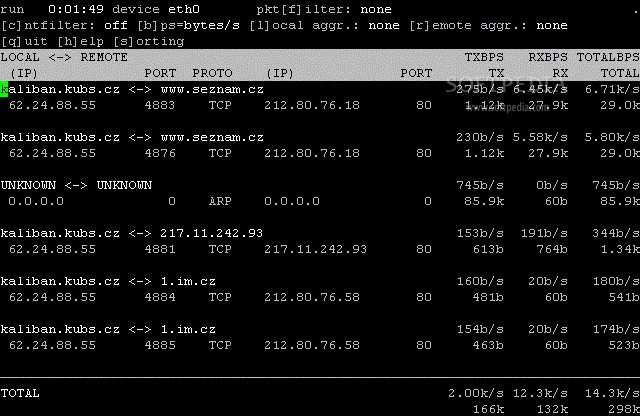
Just a quick post about jnettop, a tool I find really useful for monitoring network traffic to see what other machines a machine is talking to, and how much traffic is being sent/received between them. (It also includes traffic going via the host you’re running it on, so very useful for firewall/gateway machines.)

Jnettop is a traffic visualiser, which captures traffic going through the host it is running from and displays streams sorted by bandwidth they use.

Basic screenshot:

Useful stuff.

Leave a Comment more...

Check/change key passphrase with openssl

by on Dec.14, 2010, under Linux, System Administration

Quick post for my future reference, and for anyone Googling.

To check the passphrase for a key is correct:

openssl rsa -check -in keyfilename

To change the passphrase for a key:

openssl rsa -des3 -in keyfilename -out newkeyfilename

Simples.

1 Comment more...

Debian Xen kernel won’t boot until you create initrd image

by on Dec.10, 2010, under Linux, System Administration

I recently installed Xen on a Debian Lenny amd64 box, and found that the Xen kernel would not boot, failing to mount the root filesystem:

No filesystem could mount root, tried:
Kernel panic - not syncing: VFS: Unable to mount root fs on unknown-block(0,0)

I noticed in /boot/grub/menu.lst that the standard Debian kernel included an initrd image, whereas the Xen kernel didn’t:

# This is the Xen kernel that fails to boot:
title           Xen 3.2-1-amd64 / Debian GNU/Linux, kernel 2.6.26-2-xen-amd64
root            (hd0,0)
kernel          /boot/xen-3.2-1-amd64.gz
module          /boot/vmlinuz-2.6.26-2-xen-amd64 root=/dev/sda1 ro console=tty0

# This is the standard kernel that does boot:
title           Debian GNU/Linux, kernel 2.6.26-2-amd64
root            (hd0,0)
kernel          /boot/vmlinuz-2.6.26-2-amd64 root=/dev/sda1 ro quiet
initrd          /boot/initrd.img-2.6.26-2-amd64

To get the Xen kernel working, I needed to create an initrd image, with:

dave@devvps:/boot$ sudo update-initramfs -c -k 2.6.26-2-xen-amd64
update-initramfs: Generating /boot/initrd.img-2.6.26-2-xen-amd64

Then update the Xen kernel’s entry in /boot/grub/menu.lst appropriately:

title           Xen 3.2-1-amd64 / Debian GNU/Linux, kernel 2.6.26-2-xen-amd64
root            (hd0,0)
kernel          /boot/xen-3.2-1-amd64.gz
module          /boot/vmlinuz-2.6.26-2-xen-amd64 root=/dev/sda1 ro console=tty0
module          /boot/initrd.img-2.6.26-2-xen-amd64

Upon rebooting, the Xen kernel boots succesfully, and Xen appears to be working:

dave@devvps:~$ sudo xm list
Name                                        ID   Mem VCPUs      State   Time(s)
Domain-0                                     0 24106     8     r-----     22.4

So, if you’ve installed a Xen kernel on Debian, remember to create an initrd image. I’m fairly surprised that this doesn’t happen automatically when the kernel is installed, actually.

Leave a Comment more...

Resizing ext2/3 filesystem in loop file

by on Apr.06, 2010, under Linux, System Administration

Quick post, mostly for my own future reference, as I couldn’t quite remember how to resize an ext3 filesystem contained in a file.

dd if=/dev/zero of=disk.img bs=1M count=1024 oflag=append conv=notrunc
e2fsck -f disk.img
resize2fs disk.img

The above will append 1GB to the end of the file, then resize the ext2/3 filesystem to take up that newly-added space.

Leave a Comment more...

OpenDNS vs Google – speed comparison

by on Dec.03, 2009, under Perl, Programming, reviews, System Administration

I read a Twitter post earlier mentioning Google’s public DNS service, and suggesting that it could displace the popular OpenDNS

I thought it would be interesting to do a performance comparison between Google and OpenDNS, to see how they compare. I also decided to include the nameservers of my ISP, Virgin Media, to illustrate whether there are performance gains to be had by changing to OpenDNS (which I primarily use, along with others) or Google, or whether staying with defaults works. (continue reading…)

7 Comments more...

SSH key for Subversion but nothing else

by on Sep.17, 2009, under Linux, System Administration

I needed to create an account with an SSH key which could be used for Subversion, but nothing else.

The solution – forced commands with the SSH key – on the host machine, make ~/.ssh/authorized_keys look like:


command="/usr/bin/svnserve -t",from=""

Dumping this here mostly for my future reference, and for anyone who might find it useful.

This means the SSH private key on the client can be used by Subversion to check code in/out, but cannot be used for anything else (as SSH’ing to the host machine with that key simply starts ‘svnserve’, regardless of what the client asked for).

Leave a Comment more...

Mounting a Linux software RAID partition directly

by on Sep.14, 2009, under Linux, System Administration

I needed to mount a Linux software RAID partition directly to copy the data from it; it wasn’t being recognised as a RAID device (it didn’t appear in /proc/mdstat, only my newly-created array did), and attempting to mount it gave me:

[davidp@supernova:~]$ sudo mount /dev/sdc4 /mnt/tmp
mount: unknown filesystem type 'mdraid'

To get round that, I had to tell mount the filesystem type that was actually in use:

sudo mount -t xfs -o ro /dev/sdc4 /mnt/tmp

(I mounted it read-only just in case this approach wasn’t going to work; I don’t want to write to it anyway.)

Might be useful for anyone Googling (it’s pretty obvious, but it made me think for a few minutes… it’s getting late!)

The partition type appeared as ‘Linux raid autodetect’:

Disk /dev/sdc: 200.0 GB, 200049647616 bytes
255 heads, 63 sectors/track, 24321 cylinders
Units = cylinders of 16065 * 512 = 8225280 bytes
Disk identifier: 0x7bf29ced

   Device Boot      Start         End      Blocks   Id  System
/dev/sdc1   *           1         871     6996276   fd  Linux raid autodetect
/dev/sdc2             872         995      996030   fd  Linux raid autodetect
/dev/sdc3             996        1119      996030   82  Linux swap / Solaris
/dev/sdc4            1120       24321   186370065   fd  Linux raid autodetect
1 Comment more...

Synaptics touchpad under Xorg lives again

by on Feb.12, 2009, under Linux, System Administration

I have a Dell Inspiron 1501 laptop running Arch Linux, and recently, after an update, the Synaptics touchpad stopped working.

The touchpad shows up in dmesg as:

Synaptics Touchpad, model: 1, fw: 6.3, id: 0x180b1, caps: 0xa04713/0x200000
input: SynPS/2 Synaptics TouchPad as /class/input/input7

I was using a USB mouse until I found time to get the touchpad working again. Here’s what I had to do…

(continue reading…)

6 Comments more...

Pastebin Firefox extension

by on Jan.12, 2009, under Programming, reviews, System Administration

My friend James Ronan has just released a Pastebin Firefox extension, making it even easier to paste code etc to pastebin.com.

As the code by Paul Dixon which powers pastebin.com is Open Source and can be installed on your own server, the extension allows you to provide the URL of your own private pastebin install if you have one – this is ideal for me, as we have a private pastebin setup at work which is often used.

Using the extension is as simple as right clicking and chosing “pastebin my clipboard”, which submits the contents of your clipboard (or highlight buffer) to pastebin, and copies the resulting URL to the clipboard, ready for you to paste on IRC / IM / whatever.
(continue reading…)

Leave a Comment more...

Looking for something?

Use the form below to search the site:

Still not finding what you're looking for? Drop a comment on a post or contact us so we can take care of it!